
Modular Blockchain Architectures
 Michael Willson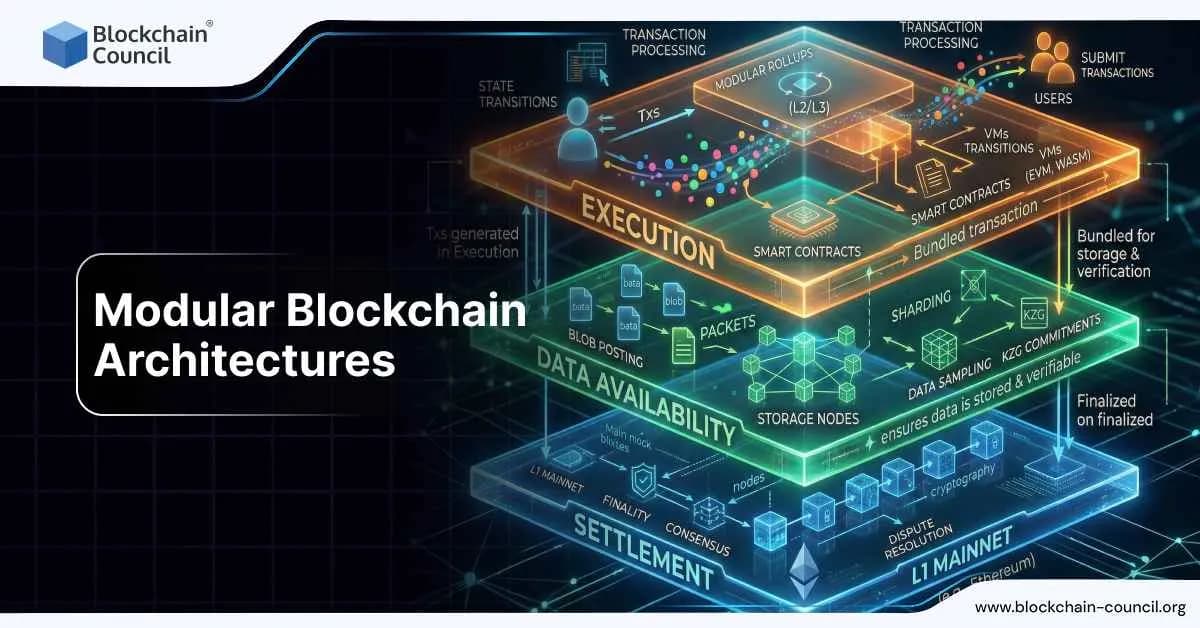
Blockchains were originally built like all-in-one appliances: one system handles execution, consensus, data storage, and settlement. It works, in the same way a single-lane road “works” until everyone tries to use it at once. Modular blockchain architectures take a different approach by splitting core blockchain functions into separate layers that can be upgraded, scaled, or swapped independently.
This design has become central to how modern ecosystems scale, especially Ethereum’s rollup-centric roadmap, where Layer 2 networks execute transactions while relying on Layer 1 for settlement and security. The modular thesis is simple: specialize each layer, then connect them with well-defined interfaces.

Monolithic vs Modular
A monolithic blockchain runs everything on one chain: execution, consensus, data availability, and settlement. A modular architecture separates those responsibilities across distinct systems, often coordinated through cryptographic proofs and shared standards.
A common modular breakdown includes four roles: execution, settlement, consensus, and data availability. Celestia’s learning materials describe this “modular stack” framing directly, emphasizing how these roles can be split rather than bundled into a single chain.
The motivation is not philosophical. It is operational: when demand spikes, you want to scale the part that is stressed (usually execution and data throughput) without forcing every node to do everything.
The Four Building Blocks
Execution
Execution is where transactions run and state changes happen. In modular systems, execution is often pushed to rollups or app-specific chains that optimize for speed, cost, or application needs. Optimism’s OP Stack documentation explicitly frames the stack as modular components that together create Layer 2 blockchains, including an execution layer that processes transactions and manages state.
Settlement
Settlement is where finality is anchored and disputes get resolved. In many modular designs, Ethereum serves as the settlement layer for rollups, verifying proofs or enabling fraud challenges, then providing the final “source of truth.”
Consensus
Consensus determines transaction ordering and agreement on the chain’s state. Some modular systems keep consensus on a base chain, while execution chains inherit security through proofs and settlement rules.
Data Availability
Data availability (DA) is the guarantee that the transaction data needed to verify a chain is actually accessible. Without DA, you can have “valid” state transitions that nobody can independently verify because the underlying data is withheld. This is why DA has become one of the biggest levers in modular design.
Why Modular Took Off
Modularity is not a trend because it sounds clever. It took off because it solves real pain points:
- Scaling without centralizing: Instead of increasing L1 capacity so much that only data centers can run nodes, modular design shifts execution elsewhere while keeping settlement secure.
- Faster experimentation: Teams can upgrade execution environments without hard-forking a global base chain.
- Customization: Chains can tune parameters like gas models, virtual machines, or privacy features while still inheriting settlement guarantees.
Ethereum’s scaling direction is a practical example of this shift. A major milestone was the Dencun upgrade’s EIP-4844 (“proto-danksharding”), which introduced blob-carrying transactions intended to reduce the cost of posting rollup data to Ethereum. This directly strengthens the modular approach by making L2 data publication cheaper and more scalable.
Modular in Practice
Rollups as Execution Layers
Rollups are the flagship execution layer in modular blockchain architecture. They execute transactions off the base chain, then publish data and proofs (or fraud-proof commitments) back to the settlement layer.
Two real frameworks show how “modular” has become a product strategy, not just a whitepaper concept:
- OP Stack: A standardized, open-source rollup stack designed to support multiple interoperable chains under the Superchain idea. Optimism’s docs describe it as a modular collection of components used to create L2 blockchains.
- Arbitrum chains and DA choices: Arbitrum documentation explains that in Rollup mode, data can be read from parent-chain calldata or blobs, while AnyTrust mode uses a Data Availability Committee approach to reduce costs with a different trust model.
The key point is that builders increasingly choose stacks and components the way engineers choose cloud services: based on trade-offs, not ideology.
Dedicated Data Availability Networks
Data availability has become its own “layer market.” Instead of forcing every execution chain to post all data to Ethereum, some systems use specialized DA layers.
Celestia is frequently cited as a DA-focused modular network. Its documentation describes Celestia as a data availability layer designed to allow execution and settlement layers to verify, in a trust-minimized way, that the data is available.
EigenDA is another approach, tied to Ethereum restaking. EigenDA documentation describes its relationship to EigenLayer and how restaked Ethereum security can be used to secure DA services.
These systems matter because DA costs often dominate rollup economics. Lower DA costs can mean lower user fees, higher throughput, and less pressure to cut security corners.
Recent Developments
EIP-4844 and the “Blob” Era
EIP-4844 is widely treated as a key step in Ethereum’s modular scaling plan because it provides a dedicated, temporary data space (“blobs”) for rollups. Multiple Ethereum ecosystem explainers note that the change is designed to reduce the cost of publishing rollup data to Ethereum.
This is not a small detail. Making data cheaper strengthens the settlement layer’s role while letting execution scale outward through rollups.
Restaking-Based Infrastructure Services
EigenLayer and EigenDA’s mainnet debut brought attention to “actively validated services,” including DA layers that borrow Ethereum economic security. The reporting around EigenDA’s launch frames it as a DA layer debuting on Ethereum mainnet via EigenLayer’s restaking system.
Stack Ecosystems and Chain Factories
Stacks like OP Stack and Arbitrum’s chain frameworks have normalized the idea that launching a chain is a configuration choice, not a bespoke research project. Optimism describes OP Stack as a shared, open-source system for creating new L2 chains. Arbitrum’s documentation similarly focuses on chain operators launching specialized rollup or AnyTrust chains with selectable DA options.
Trade-offs You Cannot Ignore
Modular architecture is powerful, but it comes with engineering and governance complexity:
- More moving parts: Execution, DA, settlement, bridges, and proof systems are separate systems, so failures can happen in more places.
- Bridge risk: Interoperability often relies on bridges, which historically attract attackers.
- Trust model choices: AnyTrust-style DA committees can reduce fees but change the trust assumptions. Arbitrum’s docs explicitly note the trade-off between reduced costs and trust-minimization.
- Operational burden: Running and monitoring a modular stack is closer to operating distributed infrastructure than deploying a single chain.
Use Cases
Gaming and Consumer Apps
High-frequency, low-value transactions are extremely sensitive to fees. Modular designs let a gaming chain run fast execution while choosing a DA model that keeps costs predictable.
Institutional and Enterprise Chains
Institutions often want customized compliance logic, permissioning, or privacy, but still want strong settlement assurances. Modular systems allow application-specific execution environments while anchoring to robust settlement layers.
DeFi at Scale
DeFi protocols increasingly deploy across multiple rollups. A modular ecosystem supports this expansion, but also increases the need for reliable interoperability and consistent security assumptions.
Skills and Certification in a Modular World
Modular blockchain systems require cross-domain competence: smart contracts, node operations, security, proof systems, and the business logic of trade-offs. That is why structured learning paths show up everywhere, because hiring for “someone who understands all of this” is otherwise just hiring for confidence.
If you are building credibility in this space, options like an AI certification can help for teams combining automation and blockchain operations, while Blockchain certification, deep tech certification, and even marketing certification can support broader roles across product, growth, and ecosystem strategy.
Yes, it is mildly absurd that “marketing” belongs in the same sentence as “data availability,” but here we are.
Conclusion
Modular blockchain architectures represent a structural shift in how blockchains scale: not by forcing one chain to do everything, but by splitting execution, settlement, consensus, and data availability into specialized layers. Ethereum’s rollup-centric roadmap, EIP-4844 blobs, dedicated DA networks like Celestia, and restaking-secured services like EigenDA all point to the same direction: scaling out through coordinated modules rather than scaling up one monolith.
The result is a more flexible, more scalable ecosystem, with the small downside that it is also more complex and therefore more capable of failing in creative ways. That is progress, in the way humans usually do it.
Related Articles
View All
Blockchain
Modular Blockchain Architecture
What is Modular Blockchain Architecture Blockchain technology has progressed far beyond its early association with cryptocurrencies. Today, it supports decentralized finance, digital identity, supply chain management, and even professional credentials such as Blockchain certificate. However, as…

Blockchain
How to Build an AI Blockchain App: Step-by-Step Guide for Developers
Learn how to build AI blockchain app projects with smart contracts, off-chain AI inference, secure oracles, testing, and deployment best practices for Web3.

Blockchain
AI Blockchain Trends: Future of Blockchain and AI Convergence to 2030
Explore AI blockchain trends shaping decentralized AI marketplaces, tokenized compute, and AI-enhanced DeFi, plus enterprise predictions through 2030.
Trending Articles

The Role of Blockchain in Ethical AI Development
How blockchain technology is being used to promote transparency and accountability in artificial intelligence systems.

AWS Career Roadmap
A step-by-step guide to building a successful career in Amazon Web Services cloud computing.

Top 5 DeFi Platforms
Explore the leading decentralized finance platforms and what makes each one unique in the evolving DeFi landscape.